
News & Media
Jeil Trading Participates in '2025 Safe Construction Expo,' Unveiling Highway Secondary Accident Pre
오지은
2026-06-22 14:56:26
Hit 51

 2025 안전건설 박람회 참가 사진.png
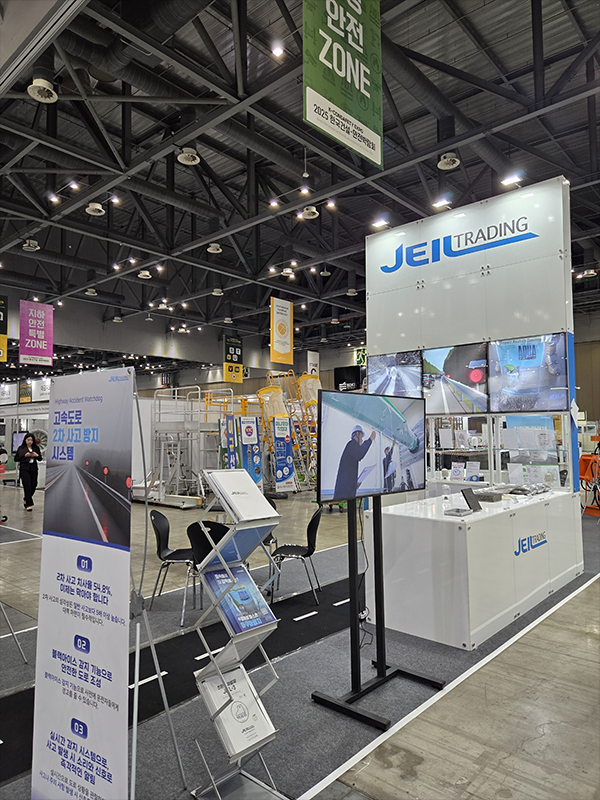
Jeil Trading announced on the 19th that it participated in the "2025 Safe Construction Expo," held from September 17 to 19 at Exhibition Hall 4 of KINTEX Hall 1 in Goyang, Gyeonggi Province, where it unveiled a highway accident detection and warning system.
According to the company, the system was developed with a focus on effectively preventing secondary accidents — situations where a driver's momentary inattention can escalate into a major disaster. Operating under the slogan "Prevention Is the Only Answer," it is an automated warning system designed to minimize casualties and property damage while reducing traffic congestion.
Jeil Trading's highway secondary accident prevention system detects sudden vehicle deceleration on highways in real time and immediately transmits warning signals to following vehicles. Comprising a "Master Unit" and "Slave Units" installed at 100-meter intervals, the Master Unit captures sudden deceleration via its built-in DNC-150T speed detection sensor and activates warning lights within 10 seconds. The signal is instantly relayed through a wireless communication module to all units within a 1km stretch behind the incident, triggering synchronized illumination across the network. This allows drivers to recognize the warning lights from distances of 2,000 meters or more and reduce their speed in advance to prevent accidents.
The system is also notably resilient in adverse weather conditions. Equipped with an AHT 30 temperature and humidity sensor, it detects driving hazards such as rain, fog, snow, and black ice, and when this data is transmitted to the server, the continuous lighting function alerts drivers to the danger. Additionally, its low-power design utilizing solar panels minimizes energy consumption, allows for easy installation even in areas without electricity, and enables up to 10 days of operation during rainfall — ensuring stable performance throughout the monsoon season and winter months.
Beyond accident prevention, the system also contributes to improving the future road environment. It continuously records and stores data on the time, date, location, and frequency of incidents in a database. This data is visualized through a website that plots accident locations on a map and displays graphs of incident counts by date and road segment, enabling administrators to identify accident-prone sections and implement preventive measures such as road infrastructure improvements.
A Jeil Trading representative stated, "The highway secondary accident prevention system will serve as a core solution for safeguarding highway safety amid rapid climate change and ever-increasing traffic volumes," adding, "We hope that through this expo, many people will experience firsthand the excellence of this system and join us in envisioning a future free from the dangers of secondary accidents."
https://www.asiatoday.co.kr/kn/view.php?key=20250919001529057

(주)제일트레이딩 대표 : 권기창 사업자등록번호: 107-87-96394
서울시 영등포구 은행로58 삼도오피스텔 1403 (여의도동 12-1) Tel : 02-3775-1040 Fax : 02-761-1046
서울시 영등포구 은행로58 삼도오피스텔 1403 (여의도동 12-1) Tel : 02-3775-1040 Fax : 02-761-1046
Copyright ⓒ Jeil Trdaing. Co., Ltd. All rights reserved.